
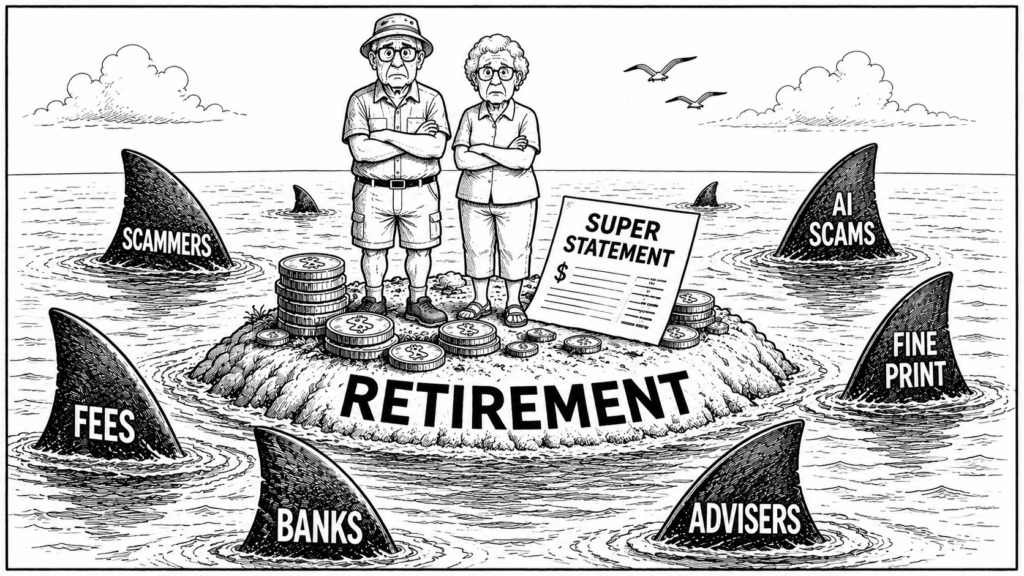
Who’s Guarding Your Super
You’d think the biggest threat to your retirement savings would be a scammer operating from a boiler room somewhere overseas. ASIC reminds us that there is another risk much closer to home: financial advisers who charge retirees exorbitant fees – up to $25,000 for advice and in a few cases 10 per cent of the super balance. ASIC blames the super platform trustees for failing to monitor fee deductions by advisers for weeks at a time despite repeated warnings from regulators.
Experts say that percentage-based advice fees are “an absolute joke”, arguing advisers can earn twice as much for doing exactly the same work simply because a client has a larger balance. ASIC says trustees have clear legal responsibilities to protect members and many simply weren’t doing enough. Australians have spent decades being told to trust the super system with their life savings. They shouldn’t also need a forensic accountant to work out whether somebody is quietly helping themselves to it.
Banks Finally In The Firing Line
For years, scam victims have found themselves in an infuriating position. Criminals emptied their bank accounts, but when they asked the receiving bank for help, they were often told, “Sorry, you’re not our customer.” Convenient, if you’re a bank. Less convenient if you’ve just watched your retirement disappear into a mule account opened by a crook with a stolen driver’s licence.
That may finally be changing. Under the government’s Scams Prevention Framework, the Australian Financial Complaints Authority (AFCA) will gain expanded powers to investigate whether banks, telcos and digital platforms failed to prevent scams and, where appropriate, order compensation. It’s a welcome reform, although there are still gaps. Phone scams, text messages, email providers and dating apps remain outside the framework. Better than nothing? Absolutely. The finished job? Not even close.
The $150,000 Click
If anyone still believes they’re too smart to fall for an online scam, this story should cure the illusion. An Australian woman lost $150,000 after fraudsters used convincing fake news reports and AI-generated images of respected finance commentator, Tom Piotrowski, to promote a bogus investment.
The crooks understand modern psychology better than many marketers. They don’t sell impossible dreams. They borrow trust, hijack familiar faces, respected brands and convincing websites until it’s impossible to recognize the lie. If you’re investing because a celebrity appears to recommend it online, spend five minutes checking first. It could save a lifetime rebuilding your savings.
The Great Super Churn
They usually call around dinner time. The churn merchants promising better returns and lower fees if only you move your super to an exciting new investment fund. They can earn big commissions if they churn you, so their message is well-rehearsed and persuasive. There is no doubt they are pretty good at it because billions of dollars flow out of retail super funds each year as Australians look for the next big thing.
We seem to change superfunds like we change phone providers. Unfortunately, the consequences last a lot longer than lost reception. The cheapest option isn’t always the best, and yesterday’s star performer has an annoying habit of becoming tomorrow’s disappointment. Here’s a story that discusses the risks and is worth reading from the ABC website.
Another Super Fund In The Dock
ASIC has also secured $10.3 million in penalties against Mercer Super after systemic reporting failures affecting thousands of members. The Federal Court found Mercer failed to provide members with required information and reports over an extended period.
It’s another uncomfortable reminder that confidence in the super system depends on competent administration as much as investment returns. Australians are compelled to save for retirement. Asking the organisations managing those savings to send the correct paperwork on time shouldn’t be setting the bar particularly high.
The Salty Summary
This week we were reminded that our retirement savings have more admirers than a Powerball jackpot. Super funds can charge eye-watering fees, scammers are becoming frighteningly convincing, banks are only now being pushed towards greater accountability and regulators are still racing to catch problems after they’ve already cost people dearly.
Someone had to say it.
In Case You Missed it:
Crims On Notice – Tougher anti-money laundering laws have kicked in, making life harder for organised crime and considerably busier for compliance departments.
Generation TikTok Advice – New research suggests younger Australians are increasingly turning to social media for financial advice. What could possibly go wrong?
The Retirement Housing Crunch – Australia’s ageing population is growing faster than suitable retirement housing, proving once again that demographics only surprise governments after they’ve happened.