
The Bond That Wasn’t
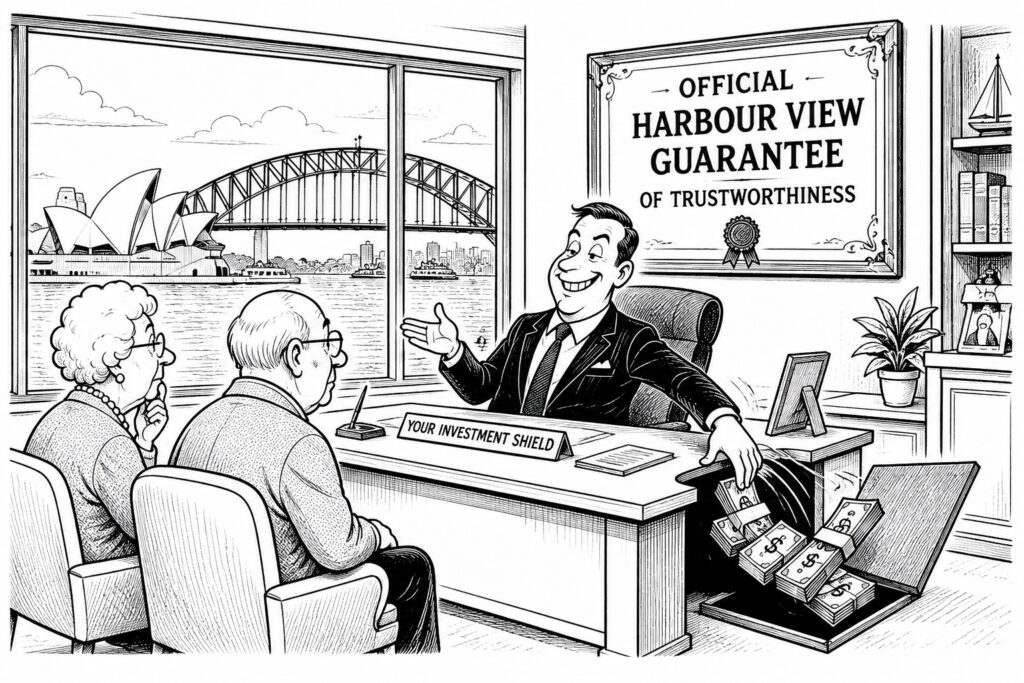
A Sydney outfit called Capital Guard spent the last few years telling investors it was “your investment shield,” complete with a swish office at 1 Macquarie Place and a Macquarie Bank bond that, as it turns out, Macquarie Bank had nothing to do with. ASIC reckons the company raised more than $17 million from around 80 investors and now says only a “small proportion” of it is still sitting in the company’s accounts. The regulator has taken Capital Guard to the NSW Supreme Court seeking to wind it up, alleging fake documents to auditors and misleading statements to boot.
One Wollongong retiree handed over $250,000 for what she thought was a safe, passive investment heading into retirement — she even insisted on meeting the team in person, because that’s what you’re told to do. Turns out a nice office, a friendly receptionist and a branded gift basket aren’t actually proof of anything, which is the most depressing sentence we’ve written all week. Apparently, the office with harbour views was the tell nobody was watching for.
ABC News / ASIC media release
The Bank That Never Closes (Until It Does)
The Bank of Mum and Dad has been quietly propping up the property market for years, and it’s finally showing signs of strain. New data from mortgage brokerage Loan Market shows the share of first-home buyers using a family guarantee nearly halved between February and June, as parents get nervous about tying up the family home for longer than expected amid falling prices and policy uncertainty following recent budget changes to capital gains and negative gearing.
Meanwhile, new research out of the University of Newcastle — based on 80 interviews with parents and first-home buyers — found most of these arrangements start with a handshake and no paperwork, which is a wonderful system right up until someone gets sick, the relationship sours, or the parent needs the money back. Researchers note 46 Family Court matters over family loans and gifts have already been lodged this year, and there’s a genuine risk of gifts eating into the age pension or, in the worst cases, becoming a form of elder financial abuse when the money never comes home. Nothing says “family bonding” quite like a Family Court filing.
The Australian / The Senior
The Great SMSF Stampede
Self-managed super funds have until 10 August to get a residential property purchase contracted before new borrowing rules shut the door on limited recourse borrowing arrangements for housing. Naturally, this has produced exactly the kind of calm, considered decision-making you’d expect: mortgage brokers working around the clock, accountants burning the midnight oil, and buyer’s agents suddenly discovering “opportunities” in properties that would ordinarily struggle to pass a basic inspection.
Property commentator Phillip Tarrant — who has skin in the game himself, running both residential and commercial property through his own SMSF — puts it plainly: a deadline doesn’t turn a bad property into a good one, and a ban doesn’t turn a second-rate asset into a retirement strategy. His own accountant told him a that setting up an self-managed super fund because a buyer’s agent flagged a property is, in itself, a red flag.
Turns Out Getting Older Is Complicated
A new University of Sydney study, analysing the health records of more than 4.4 million Australians aged 65 and over, has confirmed what most GPs could have told you for free: multimorbidity isn’t the exception in later life, it’s the norm. Three quarters of over-65s have two or more chronic conditions, a third have five or more, and researchers found these conditions cluster into three distinct groups — cardiovascular-metabolic, neuropsychiatric-functional decline, and inflammatory-musculoskeletal-cancer.
The RACGP’s Dr Anthony Marinucci says the neuropsychiatric cluster, which combines depression, pain, dementia and incontinence, is the one that quietly drives loss of independence and entry into aged care, and it’s also the most poorly coordinated. His diagnosis for the system: Medicare still rewards quick, single-problem consultations, which is precisely the fragmented model this study warns against. Turns out treating the whole person takes more than a ten-minute slot — who knew.
RACGP newsGP
Tiny Homes, Big Idea
Now for something that doesn’t require a lawyer. Shellharbour Council has given the green light to a two-year Tiny Homes Pilot, allowing certain mobile, trailer-registered tiny homes to be used as rental accommodation without needing a full development application. Mayor Chris Homer says it’s a practical, considered attempt to make housing more flexible while keeping safety protections in place — not a permanent fix, but a genuine trial with monitoring built in before any long-term decision is made.
It’s a small, sensible step in a housing debate that’s had precious few of them lately. Nobody’s promising it’ll solve the crisis. It might just quietly help a few people find somewhere to live, which these days counts as a win.
Salty Summary
Fake bonds, family handshakes and SMSF deadlines all have one thing in common this week: someone else’s timeline, someone else’s paperwork, and your money on the table between them. The common thread isn’t malice everywhere — sometimes it’s just an unhelpful deadline or a well-meaning kid — but the thing to remember is that hope is not a financial strategy and if it comes with urgency, ask more questions, not fewer.
Someone Had to Say It!